ââåwho Has the Power? Policy Making and Politics in the Language Artsã¢ââ
Architecture is an fine art form that reflects how we nowadays ourselves across the world's landscape, and, like other expressive mediums, it changes with styles, technologies and cultural adaptations. Architecture non just provides worldly needs of shelter, workspace and storage but also represents human ideals in buildings like courthouses and government buildings and manifestations of the spirit in churches and temples. Traditional compages has survived over thousands of years in one form or another, while contemporary design offers new approaches in how we use materials and technology to shape the look of our environment.
Early Developments in Edifice Blueprint and Techniques Methods
The bones methods of edifice design and construction take been used for thousands of years. Stacking stones, laying brick, or lashing wood together in one form or another are notwithstanding used today in all parts of the earth. But over the centuries, innovations in methods and materials take given new expression to architecture and the human footprint on the mural. Nosotros tin look to historical examples for clues that requite context to different mode periods.
In western civilisation, one of the earliest settlements with permanent structures was discovered at Catalhoyuk in Turkey (pictured below). The rich soil that surrounds the settlement indicates the inhabitants relied in function on farming. Dated to about 7500 BCE, the dwellings are constructed from dried mud and brick and show wooden support beams spanning the ceilings. The design of the settlement incorporates a cell-like structure of pocket-size buildings either sharing mutual walls or separated by a few feet. The roofs are apartment and were used as pathways betwixt buildings.
Restoration of interior, Catalhoyuk, Turkey. Epitome licensed nether Creative Commons.
A pregnant advance came with the development of the post and lintel arrangement. With this, a system of posts –either rock or wood – are placed at intervals and spanned past beams at the tops. The load is distributed down the posts to permit for areas of open space between them. Its earliest utilize is seen atStonehenge (beneath), a prehistoric monument in southern England dating to about 3000 BCE.
Stonehenge, Wiltshire County, England. Image: David Ball. Image licensed under Creative Commons.
Mail and Lintel back up in contemporary employ. Image by Christopher Gildow. Used with permission.
Acolonnade continues the post and lintel method as a series of columns and beams enveloping larger areas of space. Colonnades can be gratuitous standing or part of a larger structure. Common in Egyptian, Greek and Roman architectural design, their utilise creates visual rhythm and implies a sense of grandeur. Over time columns became categorized by the upper-case letter manner at their tops. The smooth and unadornedDoric columns requite way to more elaborate styles: the scrolledIonian and the high reliefCorinthian.
Greek and Roman capitals: Top row: Doric. Eye Row: Ionic. Bottom Row: Corinthian and a composite Ionic Corinthian. Classical Orders, engraving from the Encyclopédie vol. 18. Public domain.
The Parthenon, a Greek temple to the mythic goddess Athena, was built in the fifth century BCE in Athens and is role of a larger community of structures in the Acropolis. All are considered pinnacles of classic Greek architecture. Doric colonnades march across all sides of the Parthenon, the outer purlieus of a very ordered interior floor plan.
The Parthenon, Athens, Hellenic republic. 447 BCE. Digital paradigm past Kallistos and licensed under Creative Commons
Flooring program of the Parthenon. Licensed through Creative Commons.
Another example is the colonnade surrounding St. Peter'south Square in the Vatican, Rome.
Gian Lorenzo Bernini, Colonnade at St. Peter's Square, the Vatican. 1656–67. Photo by D.F. Malan. Licensed through Creative Commons.
The pillar is part of our contemporary surroundings too. Parks and other public spaces apply them to the same consequence: providing visual and material stability in spanning areas of open up infinite.
Contemporary pillar. Image: Christopher Gildow. Used with permission.
The evolution of thearch gave architecture new alternatives to post and lintel construction. Arches appeared every bit early every bit the 2d millennium BC in Mesopotamian brick architecture. They supply force and stability to walls without massive posts and beams because their structure minimizes the shear load imposed on them. This meant walls could become higher without compromising their stability and at the aforementioned time create larger areas of open infinite between arches. In addition, the arch gave buildings a more organic, expressive visual element. The Colosseum in Rome (below), built in the get-go century CE, uses repeated arches to define an imposing merely decidedly airy construction. The fact that near of information technology is still standing today is testament to the inherent strength of the curvation.
The Colosseum, Rome, Italy. First century CE. Photo by David Iliff. Image licensed through Creative Commons.
Roman aqueducts are another example of how finer the arch was used. Tall and graceful, the arches support themselves in a colonnade and were used to transport a network of water channels throughout aboriginal Rome.
Roman channel, c. First century CE. Prototype in the public domain.
From the arch came ii more important developments: extending an arch in a linear management formed avault, encapsulating tall, narrow spaces with inverted "U" shaped ceilings. The compressive force of the vault required thick walls on each side to keep it from collapsing. Considering of this many vaults were situated hugger-mugger – substantially tunnels – connecting areas of a larger building or providing covered transport of people, goods and materials throughout the city.
An arch rotated on its vertical axis creates adome, with its curving organic scoop of infinite reserved for the tops of the most important buildings. The Pantheon in Rome sports a dome with an oculus – a round or elliptical opening at the pinnacle, that is the massive building'due south but light source.
Dome of the Pantheon with oculus, Rome. 126 CE. Epitome in the public domain.
These elements combined to revolutionize architectural design throughout Europe and the Middle Eastward in the form of bigger and stronger churches, mosques and even sectarian government buildings. Styles changed with engineering science.Romanesque architecture was popular for almost three hundred years (800 – 1100 CE). The style is characterized by barrel or groin vault ceilings, thick walls with low outside buttresses and squared off towers. Buildings reached a signal where they struggled to back up their ain weight. The architectural solution to the trouble was a flight buttress, an outside load-begetting column connected to the main structure by a segmented arch or "flyer."
Diagram of a flying buttress from St. Denis basilica, Paris. From the Dictionary of French Architecture from 11th to 16th Century (1856), licensed through Creative Commons.
Flying buttresses became a kind of exoskeleton that transferred the heavy weight of Romanesque rock roofs through their arches and into the ground, away from the edifice. They became catalysts for the Gothic style based on higher, thinner walls, pointed arches, ribbed vaults, and spired towers. Also, the thinner walls of the Gothic mode allowed for more than stained glass windows and interior illumination.
Church of St. Denis, France. 7th–twelfth centuries CE. Paradigm in the public domain
St. Denis basilica in France (above) is one of the showtime Gothic-style churches, known for its high vaulted ceilings and extensive employ of stained glass windows. The compages of the church building became a symbol of spirituality itself: soaring heights, magnificently embellished interiors and exteriors, elaborate lighting and sheer grandeur on a massive scale.
The Doges Palace in Venice, Italy (pictured beneath) housed the political aristocracy of the Commonwealth of Venice for a thousand years. Congenital in 1309 CE, its rhythmic levels of columns and pointed arches, divided by fractals as they rise, give way to elaborate geometric patterns in the pink brick façade. The ornamental additions at the acme edge reinforce the patterns beneath.
The Doges Palace, 1309 CE, viewed from St. Marking's Square, Venice, Italian republic. Image by Martti Mustonen and licensed through Creative Commons.
Majestic Architecture IN CHINA
Chinese compages refers to a way of architecture that has taken shape in East Asia over many centuries. The structural principles of traditional Chinese architecture have remained largely unchanged. Chinese architectural (and aesthetic) pattern is based on symmetry, a full general emphasis on the horizontal and site layouts that reflect a bureaucracy of importance. These considerations result in formal and stylistic differences in comparison to the West, and display alternatives in design.
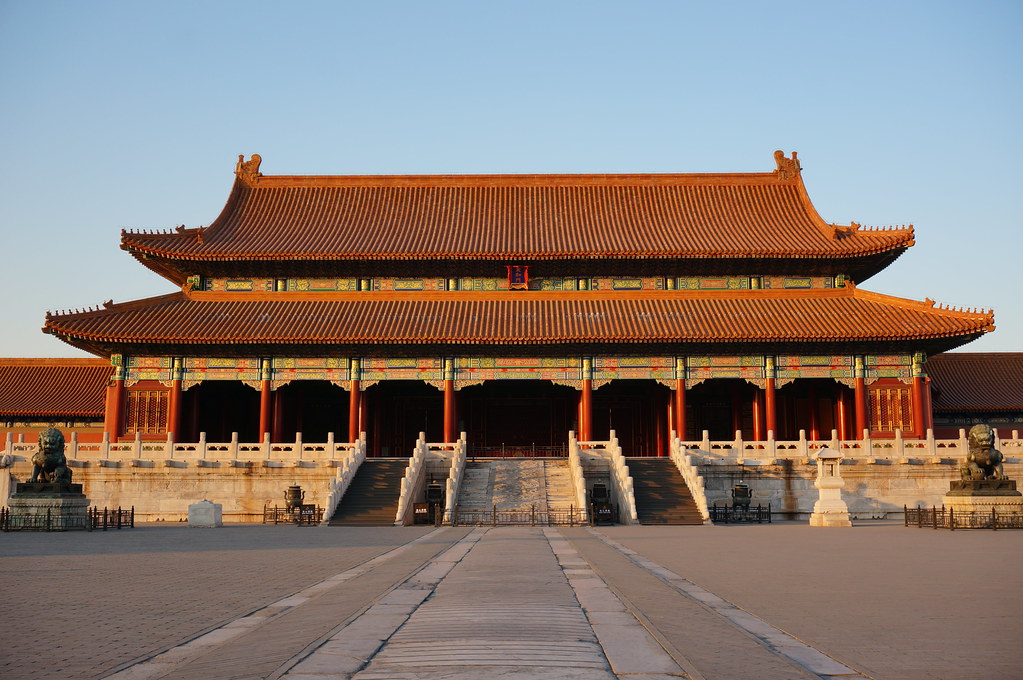
Gate of Supreme Harmony, Forbidden City, Beijing, China. Photograph Credit Andrew and Annemarie, Image licensed through Creative Commons
CROSS-CULTURAL INFLUENCES
As overland and marine trade routes expanded between Eastern and Western civilizations and then did the influence of cultural styles in compages, religion and commerce. The most of import of these passages was the Silk Road, a organization of routes that developed over hundreds of years across the European and Asian continents. Forth this route are buildings that bear witness cross-cultural influences in their design.
The Dome of the Rock in Jerusalem offers dissimilar cultural influences manifest in one building: a classic Greek pillar at the chief entrance, the golden dome and primal turret supporting it, western style arches and colorful Islamic surface embellishment.

The Dome of the Rock, on the Temple Mount, in the Old City of Jerusalem, Photo Credit Andrew Shiva, Epitome licensed through Creative Commons
The Louvre Palace in Paris, once the official royal residence and now one of the world's biggest museums, had its beginnings in the 12th century only didn't achieve its present form until recently. The building's style is French Renaissance – marked by a formal symmetry, horizontal stability and restrained decoration. The Louvre executive board chose builder I. K. Pei's glass pyramid design as the defining element for the new main entry in 1989. The selection was a not bad success: the pyramid farther defines the public space to a higher place ground and gives natural low-cal and a sense of openness to the underground lobby beneath information technology.
THE INDUSTRIAL REVOLUTION
Kickoff in the 18th century the Industrial Revolution made central changes in agriculture, manufacturing, transportation and housing. Architecture changed in response to the new industrial landscape. Prior to the tardily 19th century, the weight of a multistory building had to exist supported principally by the strength of its walls. The taller the building, the more strain this placed on the lower sections. Since there were clear engineering science limits to the weight such load-begetting walls could sustain, big designs meant massively thick walls on the ground floors, and definite limits on the building'south height.

Eiffel Tower, Start of structure of 2nd stage, May 1888. Image in the public domain
Forged atomic number 26 and milled steel began to replace woods, brick and stone equally primary materials for large buildings. This alter is encapsulated in the Eiffel Tower, built in 1889. Standing on four huge arched legs, the atomic number 26 lattice tower rises narrowly to just over grand feet high. The Eiffel Tower non just became an icon for France but for industry itself – heralding a new age in materials, design and construction methods.
In America, the evolution of inexpensive, versatile steel in the second half of the 19th century helped modify the urban landscape. The country was in the midst of rapid social and economic growth that made for not bad opportunities in architectural pattern. A much more urbanized guild was forming and the society called out for new, larger buildings. By the middle of the 19th century downtown areas in big cities began to transform themselves with new roads and buildings to accommodate the growth. The mass production of steel was the chief driving strength backside the ability to build skyscrapers during the mid 1880s.
Steel framing was set into foundations of reinforced physical, concrete poured effectually a grid of steel rods (re-bar) or other matrices to increment tensile strength in foundations, columns and vertical slabs.
MODERNIST Architecture
The move to modernism was introduced with the opening of the Bauhaus school in Weimar Germany. Founded in 1919 past the German language architect Walter Gropius, Bauhaus (literal translation "house of construction") was a pedagogy and learning center for modern industrial and architectural pattern. Though not a movement or fashion in itself, Bauhaus instructors and staff reflected different artistic perspectives, all of them born from the mod aesthetic. Information technology was partly the production of a mail service- World State of war I search for new creative definitions in Europe. Gropius'south commitment to the principle of bringing all the arts together with a focus on applied, utilitarian applications. This view rejected the notion of "art for art'due south sake", putting a premium on the knowledge of materials and their constructive pattern. This idea shows the influence of Constructivism, a similar philosophy adult concurrently in Russia that used the arts for social purposes. Bauhaus existed for fourteen years, relocating 3 times, and influencing a whole generation of architects, artists, graphic and industrial designers and typographers.
In 1924 Gropius designed the Bauhaus primary building in Dessau. Its modern class includes bold lines, an asymmetric residual and curtain walls of glass. Information technology's painted in neutral tones of white and gray accented by stiff master colors on selected doors.

Bauhaus in Dessau, Germany, 1925-26, Paradigm in public domain
Frank Lloyd Wright is considered one of the 20th century'southward greatest architects. Wright designed buildings, churches, homes and schools, but is all-time known for his design of Falling Water, a home in the Pennsylvania countryside for Chicago section store owner Edgar Kaufman. His design innovations include unified open floor plans, a residual of traditional and modern materials and the use of cantilevered forms that extends horizontal balance.
The Guggenheim Museum in New York City is an example of Wright's concern with organic forms and utilization of space. The chief element in the pattern is a spiral form rising from the middle of the cantilevered chief construction. Paintings are exhibited on its curved walls. Visitors take the elevator to the top floor and view the works equally they travel downward the gently sloped hallway. This spiral surrounds a large atrium in the centre of the building and a domed skylight at the pinnacle.

Atrium, Solomon R. Guggenheim Museum, Manhattan, New York, 1959, Image in the public domain
POST MODERN & Gimmicky ARCHITECTURE
Postmodern architecture began equally an international style whose start examples are generally cited as being from the 1950s, merely did non become a movement until the late 1970s and continues to influence nowadays-day architecture. Postmodernity in compages is mostly thought to be heralded past the return of "wit, ornament and reference" to compages in response to the formalism of the International Manner.
Michael Graves's Portland Building from 1982 personifies the idea backside postmodernist idea. A reference to more than traditional style is evident in the patterned column-like sections. Overt large-scale decorative elements are built into and onto the exterior walls, and contrasts betwixt materials, colors and forms requite the building a graphic sense of visual wit.
Nosotros can come across how architecture is actively evolving in the contemporary piece of work of Frank Gehry and Zaha Hadid. Gehry's work is famous for its rolling and bent organic forms. His gestural, erratic sketches are transformed into buildings through a figurer aided design process (CAD). They have roots in postmodernism simply lean towards a completely new modern style. They have as much to do with sculpture as they practise with compages. Seattle's Museum of Pop Civilization is an instance of the complexity that goes into his designs. Its curves, ripples and folds curl beyond space and the multi-colored titanium panels adorning the exterior accentuate the issue.
Green Architecture
In the last decade there has emerged a strong interest in developing "dark-green" compages – designs that incorporate ecologically and environmentally sustainable practices in site preparation, materials, energy utilisation and waste systems. Some are simple: buildings oriented to the s or west helps with passive solar heating. Others are more complex: Solar voltaic cells on the roof to generate power to the building. Green roofs are fabricated of sod and other organic material and act equally a cooling agent and recycle rainwater besides. In add-on, technological innovations in lighting, heating and cooling systems have fabricated them more efficient.
A co-operative of the Seattle Public Library uses green blueprint. A glass curtain wall on the north side makes use of natural lighting. Overhanging wooden roof beams shades harsh lite. The whole structure is nestled under a green roof of sod and over 18,000 low water apply plants. Vii skylights on the roof provide more than natural lighting.
Post a Comment for "ââåwho Has the Power? Policy Making and Politics in the Language Artsã¢ââ"