How to Read the Tire Size on a Tire
Installing the correct tires on your vehicle is essential to the overall performance and safety of your vehicle. Your tire option should reflect the conditions in which you bulldoze and your preferences for vehicle response and treatment. To make the most informed decision, though, you must sympathise how to read tire size when information technology's fourth dimension to purchase tires.
Thankfully, determining the right tire size for your vehicle is relatively simple. All the information you need is immediately available either in your owner's transmission or somewhere on the vehicle itself. Already know how to read tire size numbers? Skip the explanation and observe the right Bridgestone tire for your vehicle online or by visiting a Bridgestone tire dealer most you lot.
While actual, physical measurements like width and diameter are factors in finding the correct tire size, there are additional details to consider. Knowing how to read motorcar tire sizes as well means understanding terms like load index and speed rating that touch on your vehicle'south overall capabilities.
WHERE TO Find A Auto TIRE SIZE
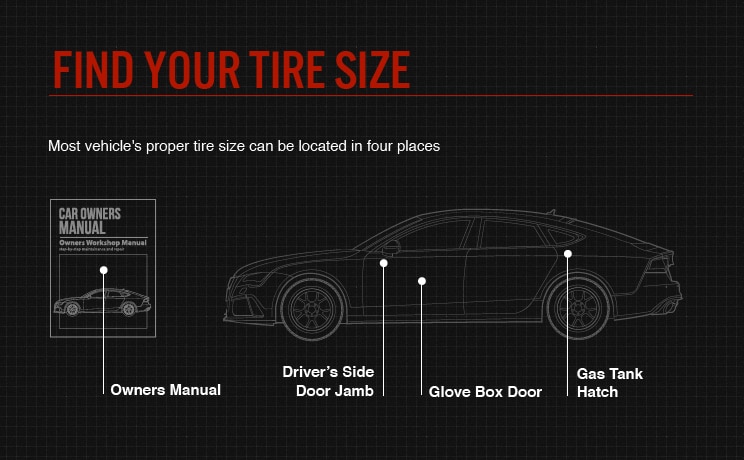
No matter what vehicle you drive, finding the manufacturer-recommended tire size should exist like shooting fish in a barrel. The all-time identify to start looking is the owner'southward manual.
Don't worry if you can't locate the manual; you may also detect a tire fit guide in these locations:
- The driver's side door jamb
- Inside your glove box door
- Within your gas tank hatch
You can also find tire size data on the sidewall of your current tires (assuming they're the proper size). However, no matter where y'all find your tire size, yous will have to decipher a sequence of numbers and letters. Don't worry if it looks confusing at first — every letter of the alphabet and number has a straightforward meaning. Let'south break down how to read car tire size.
HOW TO READ TIRE SIZE
Let'south take a await at what each number or letter stands for, one by one, in the order they appear in your tire size data. We'll be using this tire size as an instance: P225/70R16 91S.
THE LETTERS "P" AND "LT"
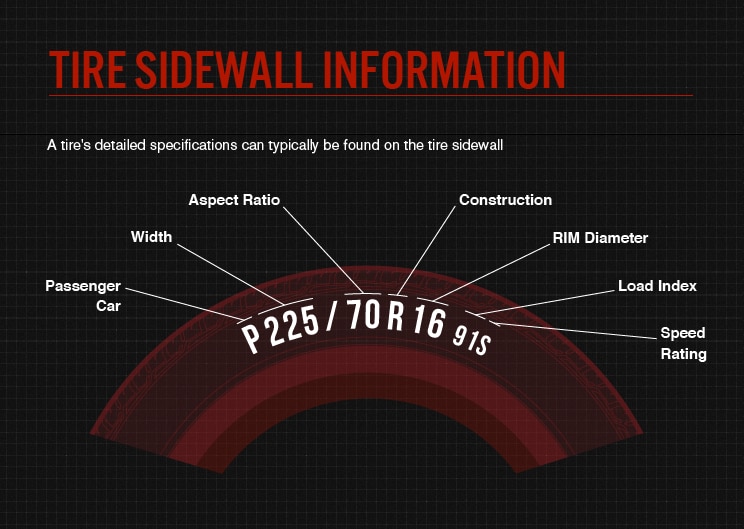
For well-nigh vehicles, you'll encounter the letter "P" earlier the number sequence begins: P225/70R16 91S. The "P" is short for "P-metric," which is a designation past the Tire and Rim Association for a "rider motorcar" tire type. A "P" signifies the tire was designed to primarily be used on passenger vehicles, which can include cars, minivans, SUV'south and other light-duty pickup trucks.
If you see "LT" instead of "P," information technology'due south because you demand "light truck" tires – "LT" is brusque for "LT-metric," which is a designation by the Tire and Rim Association for a "light truck" type tire. Light truck tires are designed to be used on vehicles capable of carrying heavy cargo or pulling trailers.
Similarly, "T" stands for "temporary" and is for your spare tire. If you encounter "ST," that ways "special trailer." A special trailer tire is never installed on the drive or steer wheels. It's simply intended for apply on trailer axles.
WIDTH
The first number to appear in your tire size information is the width, in millimeters, of the correct tires for your vehicle: P225/70R16 91S.
Tire width ever refers to the measurement from one sidewall to another. Thus, a tire with the measurement "P225" is for a rider vehicle and has a nominal width of 225 millimeters.
Attribute RATIO
Later on the slash marker, the adjacent number yous see is for the tire's aspect ratio, which essentially tells you how alpine your tire's contour is: P225/70R16 91S. Aspect ratios are delivered in percentages. Tire makers calculate the attribute ratio by dividing a tire's sidewall height by its width. If a tire has an aspect ratio of 70, information technology means the tire'south height is 70% of its width.
Lower attribute ratio tires, such as a 60 serial, generally offer vehicle handling performance advantages over higher aspect ratio tires, such every bit a 75 series.
Structure
After the aspect ratio comes a letter to indicate the tire's construction: P225/70R16 91S. "R" refers to the internal structure of your tire and gives you a general idea of its stability.
There are two types of structure that you lot may encounter on the sidewall of a tire
- R - Radial
- D - Diagonal or Bias Ply
"Bias-ply" tires were used on automobiles and light trucks until the '70s," reports the classic car site, Hemmings. But radial tires represent the vast majority of tires on the road in the United States today. In fact, you will nearly always see the letter "R" on tires as radial tires have been the industry standard for over twoscore years. Radial construction ways the tire's internal ply cords are oriented in a radial management (at 90 degrees to the centerline of the tread).
RIM DIAMETER
The next number is the wheel's diameter. For case, a tire with the P225/70R16 91S would fit a rim with a 16-inch bore.
Take note: if you lot determine to alter your rims' size, y'all will also need to get new tires that are compatible with the modify in size. Tires designed to fit a 16-inch wheel bore volition non stretch to fit on new xviii-inch rims.
View Other Common Diameter Sizes:
xiv-Inch Diameter Tires
15-Inch Diameter Tires
17-Inch Diameter Tires
18-Inch Diameter Tires
19-Inch Diameter Tires
20-Inch Bore Tires
21-Inch Diameter Tires
22-Inch Bore Tires
LOAD INDEX
The side by side effigy needed to read tire size numbers is your tire's load alphabetize. The load index tells u.s.a. how much weight, in pounds, the tire can back up when fully inflated: P225/70R16 91S.
It is chosen the load "alphabetize" because the effigy doesn't tell us the precise number of pounds the tire can back up, at least not by itself. Instead, the number corresponds to a specific load chapters listed in an index. Get-go with i and ending with 150, numbers in the load alphabetize stand for carrying capacities of 99 to 7385 lbs.
Additionally, you may not notice this number nowadays on all tires. This is considering the load alphabetize is non required past law to be printed on tires. If at that place is no load alphabetize measurement on your tires, check the owner's transmission or contact your local Bridgestone tire dealer for more information.
SPEED RATING
The final figure in a tire size sequence is the speed rating indicated past a alphabetic character: P225/70R16 91S. Just as your load index number corresponds to a particular load, your speed rating letter corresponds to a specific speed adequacy based on a standardized laboratory test.
For example, a tire with a speed rating "S" is rated for up to 112 mph, while a tire rated "R" is up to 106 mph. Think that this isn't a recommended cruising speed, merely rather the maximum speed that tire type can withstand. Of course, you should e'er follow legal speed limits on roadways.
Here are the most mutual letters for speed ratings and their corresponding maximum speeds:
- Q: 99 mph
- R: 106 mph
- S: 112 mph
- T: 118 mph
- U: 124 mph
- H: 130 mph
- V: 149 mph
- W: 168 mph
- Y: 186 mph
- ZR: 186+ mph
Tires with higher speed ratings tend to offer increased handling performance. Replacement tires must have the same or college speed rating to maintain vehicle speed adequacy. If a vehicle has tires with different speed ratings, the speed rating of the "slowest" tire dictates the vehicle's top speed.
Like the load index, the speed rating is not required by law to exist listed on all tires. If your tires do non have the speed rating listed, your possessor'south manual volition have the relevant information for your model's stock tire type.
Severe SNOW CONDITIONS
Y'all may notice "Grand+S" or "K/Southward" after the main tire size sequence on some tires. This indicates that the tire has some chapters to handle snow and mud weather. This indication is common on most radial or "R" type tires.
USDOT TIRE IDENTIFICATION NUMBER
Yous may observe another ready of messages and numbers on your tire's sidewall beginning with "DOT." This is not an indication of tire size, but rather that the tire complies with Federal Motor Vehicle Safety Standards. The "DOT" stands for Section of Transportation and is followed past the tire identification number.
The first two letters or numbers after DOT refer to the manufactory where the tire was produced and the last iv numbers indicate the calendar week and year the tire was made. The numbers 4318, for instance, indicate that the tire was manufactured during the 43rd week of 2018.
Tin I PUT LARGER TIRES ON MY CAR?
While it's certainly possible to upgrade your tires' size, information technology'due south usually best to stick to your manufacturer-recommended tire size for optimal performance. Increasing the size of your tires may give your car more footing clearance, but it may also touch on handling, drivetrain performance and fuel economy. Go on in mind the changes to central figures mentioned to a higher place, such as load index and speed rating, and how they may affect your vehicle's capabilities if you determine to increase tire size.
SHOP TIRES By SIZE
Once you know how to read the numbers on tires, you tin can explore tires by size and narrow down your tire options speedily. Compare tire sizes online or visit a Bridgestone tire dealer near you for help.
Source: https://www.bridgestonetire.com/learn/maintenance/what-is-the-tire-size-for-my-car/

Post a Comment for "How to Read the Tire Size on a Tire"